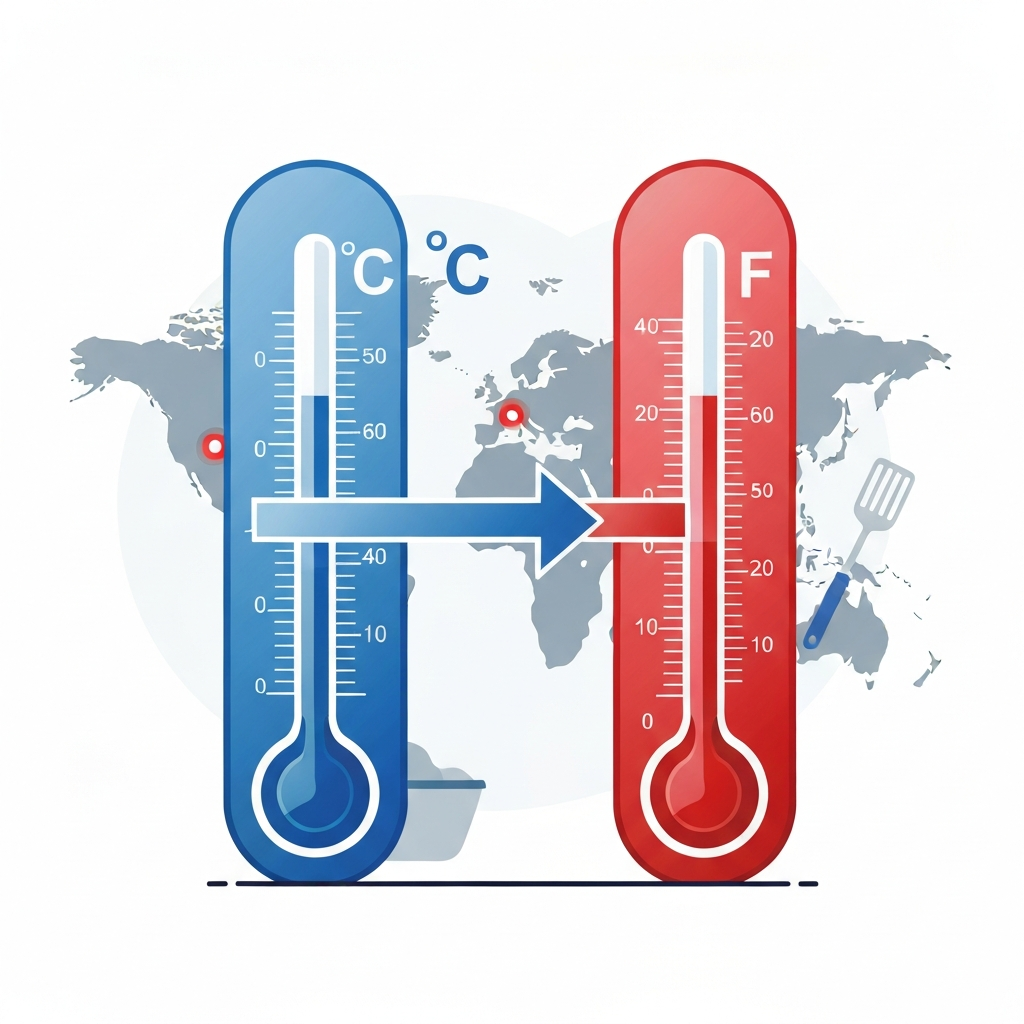
Imagine you’re excited to try a new recipe you found online, only to discover it’s written for a different continent. The oven temperature is listed in Celsius (°C), but your oven uses Fahrenheit (°F). This frustrating situation is more common than you might think, and knowing how to convert between these two temperature scales can save your baking (and your sanity!). Specifically, understanding how to convert 190°C to its Fahrenheit equivalent is a practical skill that opens up a world of culinary possibilities.
Why C to F Conversion Matters
Temperature conversions are crucial in many aspects of life, not just cooking. From understanding weather reports in different countries to troubleshooting appliance settings, having a grasp of Celsius and Fahrenheit is incredibly useful.
For instance, if you’re traveling abroad, you’ll encounter Celsius for everything from the weather to the temperature of your hotel room. Being able to quickly convert these values helps you make informed decisions and avoid confusion. This is particularly true when it comes to cooking, where precise temperatures can make the difference between a perfectly baked cake and a burnt disaster.
Cooking and Baking: The Biggest Beneficiary
The kitchen is where the Celsius to Fahrenheit conversion shines. Many recipes, especially those from Europe or Australia, will list oven temperatures in Celsius. A common temperature like 190°C needs to be accurately translated to Fahrenheit for your oven. Without this conversion, you might be guessing, which is a risky business when it comes to baking. A difference of even a few degrees can significantly alter the outcome of your dish. Fortunately, the conversion formula is straightforward, and understanding it will empower you to tackle any recipe, regardless of its origin. You can find a helpful guide on converting oven temperatures at 190 c to f.
Beyond the Kitchen: Global Understanding
While cooking is a primary driver for learning this conversion, it’s not the only one. Understanding temperature scales is fundamental to global communication and information. When you read news from international sources, weather forecasts, or even product specifications, you might encounter Celsius. Being able to mentally (or quickly calculate) the Fahrenheit equivalent allows for a more comprehensive understanding of the information presented. This skill helps bridge communication gaps and fosters a more interconnected worldview. For a deeper dive into the history and science behind temperature scales, you can explore resources on Wikipedia’s page on Temperature.
How to Convert 190°C to Fahrenheit
The formula to convert Celsius to Fahrenheit is: (°C × 9/5) + 32 = °F.
Let’s apply this to 190°C:
- First, multiply 190 by 9/5: 190 × 9 = 1710. Then, 1710 ÷ 5 = 342.
- Next, add 32 to the result: 342 + 32 = 374.
So, 190°C is equal to 374°F. This means if a recipe calls for 190°C, you should set your oven to 374°F. Understanding this simple calculation ensures your recipes turn out just as intended. For more details on oven temperature conversions and why precision matters, Love Cake Bake offers excellent guidance.
Common Conversion Points
While 190°C is specific, knowing a few key conversion points can be very handy. For example, 0°C is 32°F (freezing point of water), and 100°C is 212°F (boiling point of water). Room temperature is often considered around 20-25°C, which translates to 68-77°F. Familiarizing yourself with these benchmarks can make quick estimations easier. For a broader understanding of temperature measurement and its applications, resources from National Institute of Standards and Technology (NIST) can be insightful.
Frequently Asked Questions (FAQs)
What is the exact formula for converting Celsius to Fahrenheit?
The formula is to multiply the Celsius temperature by 9/5 (or 1.8) and then add 32.
Why is 190°C a common baking temperature?
190°C is often used for baking cakes, cookies, and bread, as it provides a good balance for browning and cooking the interior without drying out the exterior too quickly.
Are there online tools to help with conversions?
Yes, many websites and apps offer free temperature conversion calculators. You can simply type in the temperature you want to convert, and it will provide the equivalent in the other scale.
Is it better to use Celsius or Fahrenheit for cooking?
The “better” scale depends on your oven and the recipe. If your oven displays both or can be set to Celsius, and the recipe is in Celsius, using that directly is often easiest. If not, accurate conversion is key. For more on understanding temperature scales in cooking, Love Cake Bake is a great resource.
Conclusion
Mastering the conversion between Celsius and Fahrenheit, especially for common temperatures like 190°C to 374°F, is a practical skill that enhances everyday life. From ensuring culinary success with international recipes to better understanding global information, this knowledge bridges gaps and simplifies communication. By understanding the simple formula or using readily available tools, you can confidently navigate different temperature scales and enjoy a more seamless experience in the kitchen and beyond. For further exploration into the world of measurement, resources like those from Forbes can offer additional context.